AI in Identity & Access Management: The Key to Security, Scalability, and Resilient Business Operations

Artificial Intelligence (AI) is transforming Identity & Access Management (IAM). Discover how AI detects security risks early, automates access decisions intelligently, and helps organizations implement Zero Trust, maintain compliance, and scale identity management effectively.


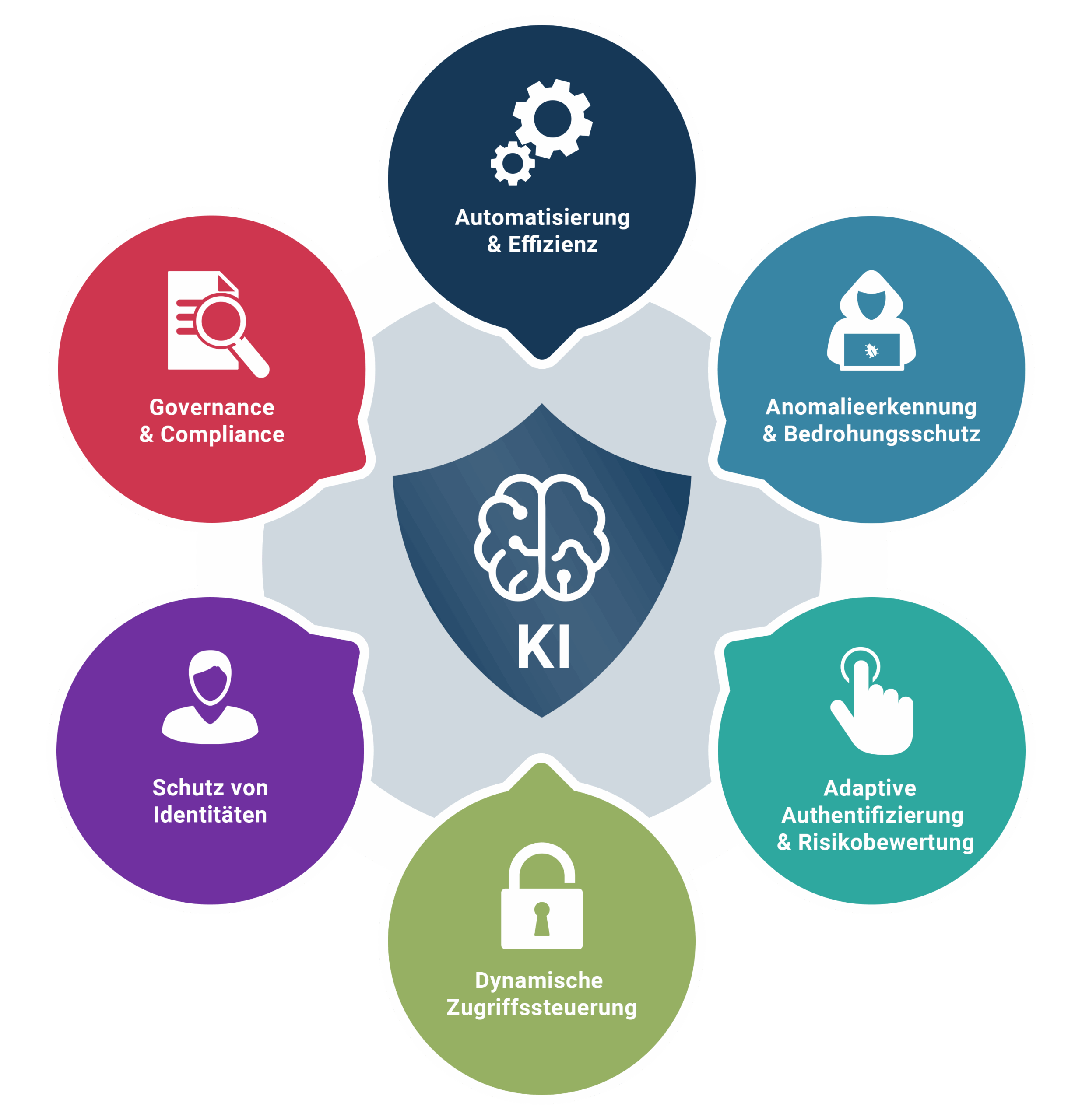
AI has evolved from a nice-to-have technology into an essential business enabler and a cornerstone of modern cybersecurity architectures. The advantages of integrating AI into Identity & Access Management are clear.
Provisioning, deprovisioning, and password management remain some of the most time-consuming IAM processes. AI-powered solutions automate these repetitive tasks, reducing manual effort while increasing speed, accuracy, and operational efficiency. This allows IT teams to focus on higher-value strategic initiatives.
Static rules are no longer sufficient to detect suspicious activity in today’s threat landscape. Machine learning algorithms identify unusual login times, risky access attempts, and deviations in user behavior patterns at an early stage. This proactive approach helps organizations detect insider threats and external attacks before they escalate.
Rather than relying on a one-size-fits-all approach, AI enables dynamic, risk-based authentication. Contextual information—including user location, device, and the sensitivity of the requested resource—is evaluated in real time. This supports risk-based Multi-Factor Authentication (MFA) and Just-in-Time (JIT) access without compromising the user experience for low-risk activities.
AI replaces static permission models with continuous, context-aware risk analysis. This enables organizations to operationalize Zero Trust by granting access dynamically based on real-time risk assessments rather than predefined rules alone.
Alongside human users, machines, bots, applications, and AI agents increasingly operate as independent digital identities. These Non-Human Identities (NHIs) require transparent, AI-driven governance and authorization models. Only then can organizations consistently enforce the principle of least privilege while maintaining accountability and auditability.

AI has become a true game changer for both security and compliance. Increasingly, it is not simply supporting IAM—it is driving it.
Organizations that approach Identity & Access Management without AI-powered processes and governance mechanisms face increasing operational costs, expanding security risks, and growing regulatory challenges.
AI is no longer an optional enhancement for Identity & Access Management—it is a critical success factor for delivering security, efficiency, and scalability across both human and non-human identities.
Subscribe to our newsletter to receive regular insights into Identity & Access Management.
By subscribing, you agree to our Privacy Policy.

The NIS2 Directive (Network and Information Security) is an EU-wide regulation designed to improve the cybersecurity of organizations.…
read more →
Role-Based Access Control (RBAC) simplifies access management, reduces security risks, and creates transparent authorization concepts. Discover how RBAC…
read more →
A digital lifecycle never ends with onboarding, which is why a comprehensive identity and access strategy forms the…
read more →Let's assess together how resilient and future-ready your Identity & Access Management strategy really is.
We use cookies to optimize our website and our services. In addition, we use Matomo (formerly Piwik), the open-source web analytics platform, to collect anonymized usage statistics from our website visitors. For more information, please read our Cookie Policy