RBAC (Role-Based Access Control): Revolutionary Simplicity for Your IT Security

Role-Based Access Control (RBAC) simplifies access management, reduces security risks, and creates transparent authorization concepts. Discover how RBAC provides the foundation for a secure, scalable, and efficient IT security strategy.

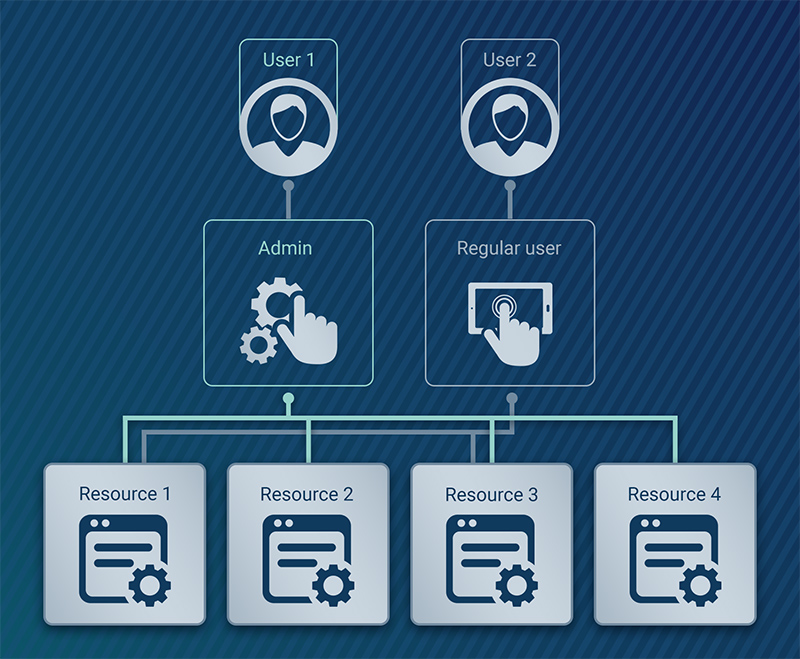
RBAC (Role-Based Access Control) is an approach that makes access to IT resources simpler, more secure, and more efficient. Anyone who has ever managed an Active Directory environment—or discussed access rights with IT—knows how quickly permission management can become an overwhelming and opaque challenge. The result is reduced transparency, a larger attack surface for unauthorized access, and ultimately increased risk for the entire organization.But it doesn’t have to be this way. RBAC demonstrates that true innovation lies in simplicity. Combined with concepts such as Zero Trust and Identity & Access Management (IAM), RBAC elevates IT security and identity management to a new level.

RBAC
RBAC - Serverraum

Why RBAC? The Power of Clarity and Control

Security and efficiency go hand in hand. One cannot be sustainable without the other. RBAC delivers both.

Efficiency Through Structure

Have you ever tried managing thousands of individual user permissions? RBAC organizes permissions through roles rather than individual accounts, saving time while significantly reducing human error. When combined with an IAM solution, roles and identities can be centrally managed by business departments, further increasing efficiency and creating significant cost savings.

Security Through Least Privilege

With RBAC, every user receives exactly the access they need—no more and no less. This principle of least privilege dramatically reduces the risk of security breaches. When combined with a Zero Trust approach, where every access request is continuously verified, organizations achieve an even higher level of security.

Scalability

Whether you’re a growing business or a global enterprise, RBAC scales with your organization. Roles can be modified, expanded, and delegated without redesigning the entire authorization model. IAM solutions further simplify onboarding new users and adapting permissions as business requirements evolve.

How to Implement RBAC

Die Implementierung von RBAC mag wie die Entwicklung eines neuen Produkts erscheinen. Mit den richtigen Prinzipien wird dieser Prozess jedoch zu einem Game-Changer:

1. Analyze Business Roles

Define the roles and responsibilities within your organization. Who performs which tasks? What access do they actually require?

List all the resources that need to be protected. Clearly define which roles are authorised to access which resources. Under a zero-trust model, these permissions should be reviewed regularly. This is a task where your IAM can assist you.

Assign the appropriate role to each employee. Automate this process as much as possible to avoid errors. IAM systems help to make the assignment process efficient and transparent.

IAM systems are not a one-way street. Regularly review and update your roles and permissions to remain flexible and secure. As part of this process, incorporate zero-trust audits to identify potential vulnerabilities.

RBAC Personen Netz

Common Pitfalls When Introducing RBAC

Migrating to RBAC is an investment in your organization's future security—but there are challenges to avoid.

Poorly Defined Roles

One of the biggest risks is creating roles that are either too broad or too granular. Overly broad roles grant unnecessary permissions and increase security risks, while overly detailed roles create unnecessary complexity and administrative overhead.

Without clear communication and training, RBAC may meet with resistance. Users and administrators need to understand the benefits and have their roles clearly assigned.

Existing processes are often not analysed thoroughly enough. This results in gaps that make the RBAC system inefficient or restrict important access rights.

Choosing the right IAM and zero-trust solutions is crucial. Without the right tools, managing roles and permissions can quickly become a challenge.

RBAC is not a ‘set it and forget it’ system. Roles, permissions and users must be reviewed and updated regularly to keep pace with changing requirements.

Best Practices for a Successful RBAC Implementation

Involve Stakeholders

Include all relevant business units and departments from the beginning. Only then can roles be defined realistically and gain organization-wide acceptance.

Start with Pilot Projects

Begin with smaller implementations to validate functionality, identify issues early, and refine the role model before rolling it out company-wide.

Document Everything

Clearly document roles, permissions, and processes to simplify administration and accelerate employee onboarding.

Leverage Automation

Use IAM platforms and Zero Trust principles to automate identity and access processes. This reduces manual effort, minimizes errors, and saves valuable time.

Think Long Term

RBAC is not a one-time project—it’s a long-term strategy. Plan for ongoing maintenance, employee training, and regular reviews from the outset.

RBAC: More Than Just Security

RBAC is more than a technical solution—it’s a philosophy.

It embraces the principle that simplicity leads to stronger, more effective systems. By implementing RBAC, organizations create not only a more secure environment but also one built on clarity, consistency, and efficiency.

When combined with Zero Trust and Identity & Access Management (IAM), RBAC forms a robust, scalable, and cost-effective security strategy. At its core lies a simple truth: Reducing complexity increases effectiveness.

RBAC is a cornerstone of modern cybersecurity. It is intuitive, scalable, and essential in a world where data is one of an organization’s most valuable assets. Integrate RBAC, Zero Trust, and IAM into your security strategy to strengthen resilience and prepare your organization for the future.

Technology doesn’t have to be complicated—we often make it that way. RBAC proves that simplicity is the ultimate sophistication. Transform your IT security into a strategic advantage with RBAC—the role-based approach that moves your business forward.

Newsletter

Stay Informed

Subscribe to our newsletter to receive regular insights into Identity & Access Management.

    By submitting this form, I consent to the processing of the data I have provided for the purpose of handling my enquiry.
    I may withdraw this consent at any time with future effect. Further information: Privacy Policy.
    Read More

    Related Articles

    Ready for an Initial Consultation?

    Let's assess together how resilient and future-ready your Identity & Access Management strategy really is.