Home • Services

Value Added
First.

Comprehensive services to optimize your

digital business processes and data security.

A Smooth Start to Your IAM, CIAM, or IGA Project


Our services are always designed for long-term collaboration with our customers. We support you throughout your entire “IAM journey” — from raising awareness of IAM topics, conducting assessments and requirements and maturity analyses, and supporting tool selection processes through to implementation, ongoing operational support, and the further development of your solution. We always work according to a value-added principle — in other words, everything we do should create tangible value for our customers.

Trusted by Companies That Take Security Seriously

Identity & Access Management (IAM) &
Identity Governance & Administration (IGA)


Employees change departments, take on new responsibilities, or leave the organization. Every change can result in new access rights. Without clear processes, the number of permissions can quickly grow beyond control.

Problem

Over time, IT loses track of who is allowed to access which systems. Outdated permissions remain active, responsibilities become unclear, and audits become unnecessarily complex. At the same time, the risk of unauthorized access increases.

Outcome

With centralized Identity Governance, access rights are managed throughout an employee’s entire lifecycle — from joining the organization to leaving it. Roles, access requests, and approvals are handled transparently and automatically. This creates greater transparency, reduces risks, and makes it easier to meet compliance requirements.

Privileged Access Management (PAM)


Administrators and super users have unrestricted access to your most sensitive data and systems. If these highly privileged accounts are not comprehensively protected and monitored, they become prime targets for cyberattacks and insider misuse.

Problem

Unsecured administrator passwords, permanent elevated privileges, and missing logging of critical access provide attackers with an easy entry point. A single compromised administrator account can bring an entire IT infrastructure to a standstill.

Outcome

Strong Privileged Access Management secures, isolates, and monitors all privileged accounts. Access rights are granted only for a limited period and based on defined roles. Every critical session is documented in a traceable manner to help prevent misuse immediately.

Non-Human Identity Management


People are not the only ones accessing your corporate data. Applications, bots, APIs, and cloud services use digital identities and secrets around the clock to communicate with one another. These machine identities often outnumber human users many times over and are frequently overlooked when it comes to security.

Problem

Vast numbers of API keys, tokens, and certificates are distributed throughout the organization — often hard-coded into source code, expired, or equipped with excessive privileges. Attackers deliberately exploit these unmonitored and orphaned credentials as entry points.

Outcome

Centralized Non-Human Identity Management provides visibility into all machine identities. It manages permissions according to the principle of least privilege, automates the regular rotation of secrets, and continuously monitors traffic between systems.

Single Sign-On (SSO)


Employees use dozens of different software tools and cloud services every day. This creates an unmanageable password landscape in their daily work. The result: insecure passwords written on notes, constant logins, and an overloaded IT support team dealing with forgotten credentials.

Problem

Multiple logins per employee reduce productivity and significantly increase security risks. At the same time, the IT department loses visibility into who has access to what and whether accounts are actually deleted across all systems when an employee leaves the organization.

Outcome

Single Sign-On enables secure access to all approved applications with a single, centralized login. Combined with Multi-Factor Authentication (MFA), it strengthens account security while maximizing user convenience and significantly reducing the burden on IT support.

Where Are You on Your IAM Journey?


Strong identity management builds trust at every level of your organization.

You Haven’t Implemented
an IAM Solution Yet?


We can support you with the following services:

  • Pre-Packaged Services
  • Assessments
  • Awareness & Training
  • Requirements & Maturity Analysis
  • Tool Selection

You Are About to Implement or
Are Already Implementing a Solution?


We can support you with the following services:

  • IAM Solution Implementation & Integration
  • Professional Project Support
  • Role Model Development & Role Design
  • Strategy & Process Consulting

You Have Already
Implemented Solutions?


We can support you with the following services:

  • Assessments
  • Strategy & Process Consulting
  • Solution Support
  • Managed Services

Let's Get Started Together

A conversation with our experts will show you where your opportunities lie.

Our Process

How We Work

From the initial analysis to ongoing operations. Every step is carefully considered, and every step matters.

01

Assessments

We take a close look at your situation. Assessments show you where you stand and which paths forward are available.

02

Architecture & Consulting

Good architecture is invisible until it is missing. We design solutions that meet your needs today and tomorrow.

03

Implementation

Plans become systems. We integrate solutions into existing environments without disrupting what already works.

04

Managed Service

Long-term operations require experience. We take care of your IAM environment so you can focus on your core business.

Interesting

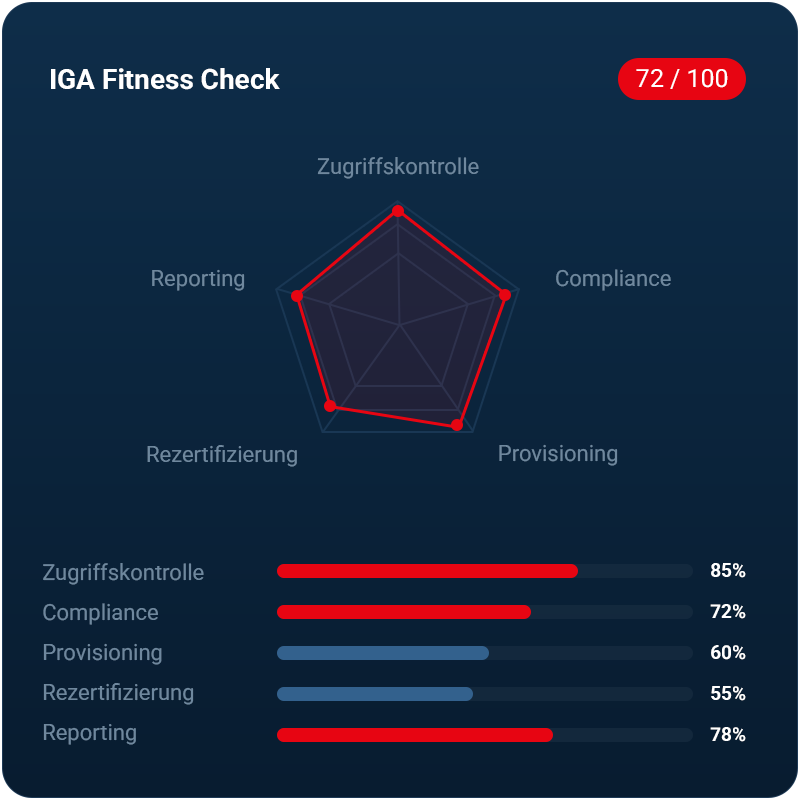
IGA Fitness Check

Get a structured assessment of your Identity Governance in a short period of time, benchmarked against regulatory requirements such as NIS2 and DORA.

  • Gap analysis against regulatory best practices
  • Assessment of your current IGA maturity
  • Prioritized recommendations for action
IGA Fitness Check
FAQ

Frequently Asked Questions

Here you will find answers to the most important questions
about our services and solutions.

IAM, IGA and PAM: What is the difference?
Identity & Access Management (IAM) is the overarching term for managing digital identities and access rights. Identity Governance & Administration (IGA) is the discipline that controls and reviews permissions throughout the identity lifecycle: employee onboarding, role changes and offboarding, role models, regular access reviews, and segregation of duties. Privileged Access Management (PAM) provides additional protection for accounts with elevated privileges, such as administrator, root, and service accounts, through password vaulting, time-limited access, and session recording. We advise on and implement all three disciplines, ensuring that they work together seamlessly.
The EU NIS2 Directive requires demonstrably controlled access rights: documented processes for granting and revoking access, multi-factor authentication, enhanced protection for privileged accounts, and regular reviews of existing permissions. The German implementation act has been in force since December 6, 2025, without a transition period. Violations can result in fines of up to EUR 10 million or 2% of annual turnover, and management can be held personally liable. NIS2 does not prescribe any specific software. We translate the requirements into concrete measures for your system landscape and provide the evidence required by auditors.
Start with your own requirements, not with a vendor demo. Which target systems need to be integrated? Which compliance evidence must be provided? Who will operate the solution later? We conduct vendor-independent tool selection processes using a weighted requirements catalog, proof of concept with your own systems, and an assessment of total costs over five years rather than licensing costs alone. Because we implement and operate multiple platforms, we know their strengths and limitations from practical experience.
A role model bundles individual permissions into business roles, such as “Procurement Specialist,” which are automatically derived from attributes in the HR system, such as department, location, and function. Without a role model, Identity & Access Management remains a ticketing system with manual access provisioning. With a role model and automated onboarding and offboarding processes, manual effort in access management can be reduced by 40–60%. Developing the role model is a responsibility of the business departments, not IT. We facilitate this process and keep the model lean enough to ensure that it is maintained in practice.

A complete onboarding or offboarding process involves more than accounts and permissions: hardware, access cards, training records, approvals from data protection or works councils, and the return of devices. These steps often take place before or after the actual Identity Management system and can only be mapped there with considerable programming effort. We connect them through process orchestration to create an end-to-end workflow that assigns tasks, obtains decisions from the appropriate people, and tracks status. The IGA system remains the authoritative source for identities and access rights. Orchestration handles everything beyond that scope.

Without additional authentication factors, yes: a stolen Single Sign-on (SSO) password provides access to all connected applications. That is why we implement SSO exclusively with multi-factor authentication, preferably passwordless using passkeys or smartcards, combined with policies based on device, location, and risk. This makes SSO more secure than dozens of individual passwords because there is a single point at which blocking, logging, and policies can be enforced. Password resets, one of the most common helpdesk requests, can be reduced by up to 80%.
An Identity Governance & Administration system answers the three key questions of every audit through reporting: Who currently has which access, who approved it and when, and when was it last reviewed? Regular access reviews, segregation-of-duties checks, and automatic account deactivation when employees leave provide the evidence required for ISO 27001, NIS2, DORA, and the German Federal Office for Information Security (BSI) IT-Grundschutz. Accounts belonging to former employees are deactivated and only deleted after the applicable retention period has expired. We configure the processes so that auditors can understand and trace them without additional explanation.