Identity Governance & Administration in 2026: Regulations, Trends, and Best Practices for Critical Infrastructure

Identity Governance Becomes the Foundation of Cybersecurity

In 2026, Identity Governance & Administration (IGA) has become one of the most critical pillars of enterprise cybersecurity. As hybrid IT environments grow more complex, business-critical processes become increasingly digital, and the number of both human and non-human identities continues to rise, modern, audit-ready identity governance is no longer optional. Regulatory frameworks designed to strengthen digital resilience—including NIS2 and DORA—are further accelerating this shift, placing IGA at the center of Governance, Risk & Compliance (GRC), particularly for operators of Critical Infrastructure (KRITIS).
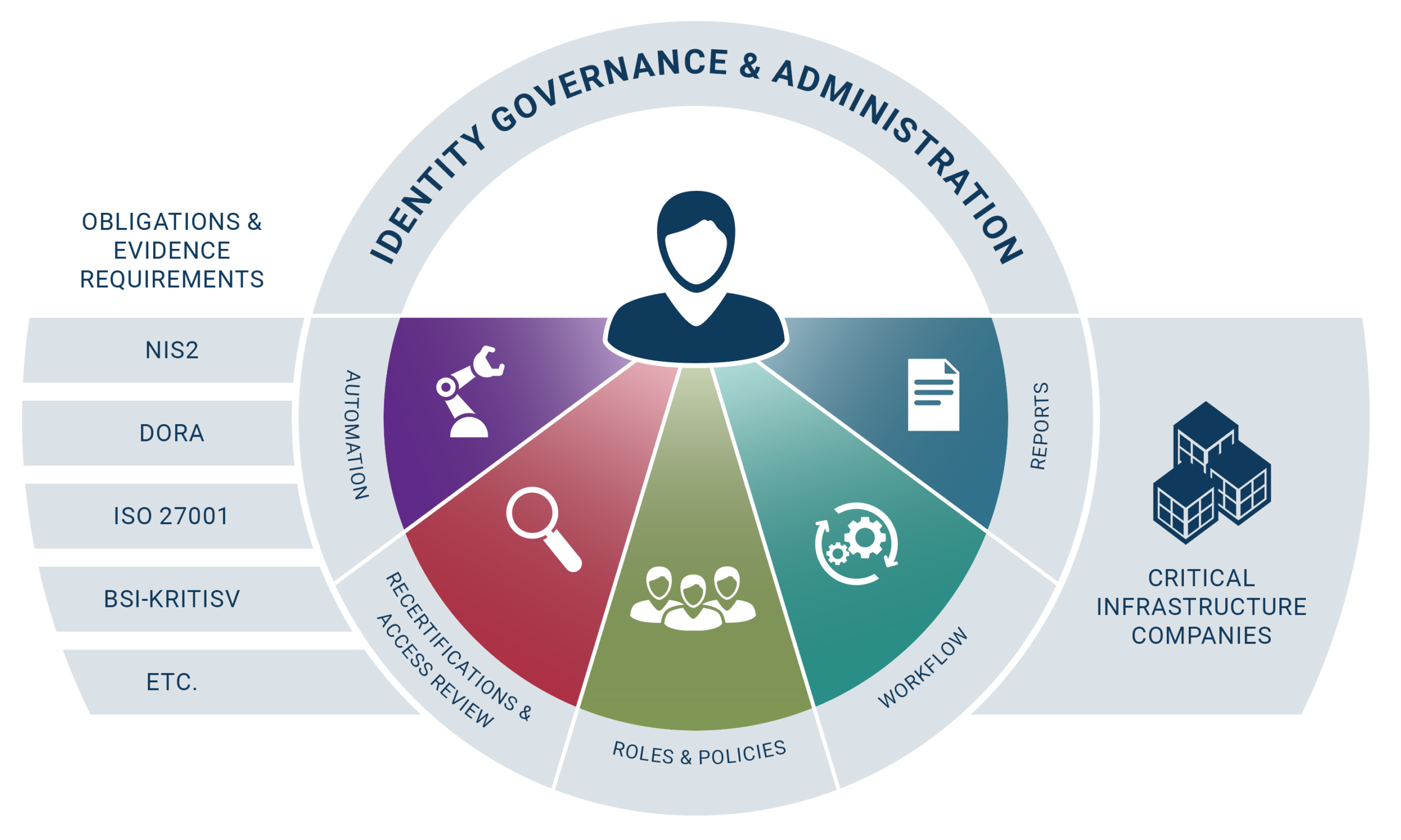
IGA Scaled

Regulatory Pressure: How NIS2 Is Reshaping Identity Governance

The European Union’s NIS2 Directive significantly raises cybersecurity expectations across essential and important entities. The directive expands the number of organizations subject to cybersecurity requirements while mandating:

  • Comprehensive cyber risk management
  • Strict identity and access controls
  • Executive accountability for cybersecurity governance

Identity and access processes must be secure, fully documented, and demonstrably auditable. At the same time, stricter incident reporting requirements and substantial financial penalties increase the pressure to establish efficient, compliant Identity Governance processes. For Critical Infrastructure operators, these obligations are reinforced through national cybersecurity legislation, KRITIS regulations, and sector-specific security requirements.

Blog IGA 2026

DORA: Digital Operational Resilience Starts with Identity

The Digital Operational Resilience Act (DORA), effective since January 2025, applies similar principles to banks, insurance companies, and financial institutions. DORA recognizes identities as a core element of ICT risk management and requires clearly defined, documented, and regularly tested processes that support digital operational resilience.

Third-party IT providers and cloud service providers receive particular attention, as outsourced identity services increasingly represent a critical cybersecurity risk. Although NIS2 and DORA apply to different industries, they share the same objective: A robust, automated, and fully auditable Identity Governance framework spanning all systems, identities, and service providers.

IGA Becomes the Core of Modern Identity Security

The Identity Governance market is evolving rapidly. IGA is no longer simply a tool for managing permissions—it has become the strategic backbone of modern Identity Security. Several trends are driving this transformation:

  • Zero Trust replaces the traditional network perimeter with identity-centric security.
  • Non-Human Identities—including IoT devices, APIs, machine identities, and AI agents—continue to grow exponentially.
  • Organizations require standardized role models, automated governance processes, and continuous controls to manage increasingly complex identity ecosystems.

At the same time, Identity Governance & Administration (IGA), Privileged Access Management (PAM), and Cloud Infrastructure Entitlement Management (CIEM) are converging into integrated Identity Security platforms.

AI-powered analytics further enhance security by identifying excessive permissions, unusual access behavior, and outdated role assignments before they become security risks.

Automation: The Key to Compliance and Operational Efficiency

Meeting today’s regulatory requirements efficiently is impossible without automation. Organizations should automate the complete Joiner-Mover-Leaver (JML) lifecycle, including:

  • Employee onboarding
  • Internal role changes
  • Employee offboarding

Automated lifecycle management reduces manual effort, eliminates orphaned accounts, and minimizes security risks. Self-service portals are becoming equally important by allowing business users to request, review, and manage access rights through structured approval workflows.

Automated access certifications and recertification campaigns create audit-ready documentation, simplifying compliance with regulatory audits conducted by national cybersecurity authorities and industry regulators.

Standardized integrations, implementation templates, and best-practice role models further reduce deployment time—especially within complex Critical Infrastructure environments.

IGA Analyse

Critical Infrastructure Faces Growing Challenges

The coming years will be particularly demanding for Critical Infrastructure operators. Cyber threats continue to increase across both traditional IT environments and Operational Technology (OT). Attacks against energy providers, utilities, water suppliers, and other essential service operators are becoming more sophisticated and more frequent. At the same time, regulatory oversight is intensifying.

Auditors increasingly focus on:

  • Identity approval workflows
  • Access control systems
  • Access certification processes
  • Incident response capabilities
  • Executive accountability for cybersecurity governance

Senior management is now directly responsible for ensuring that identity-related security controls operate effectively. Organizations must therefore assess their cybersecurity maturity, consolidate fragmented identity solutions, and establish an integrated Identity Security ecosystem that combines IAM, IGA, PAM, and cloud security into a unified governance model.

OEDIV SecuSys: Industry Expertise Meets Technical Excellence

Selecting the right implementation partner is becoming increasingly important.

With more than two decades of experience in Identity & Access Management, OEDIV SecuSys GmbH combines deep technical expertise with extensive experience supporting organizations operating within Critical Infrastructure sectors.

Conclusion: 2026 Marks a Turning Point for Identity Governance

The year 2026 represents a defining moment for organizations investing in modern Identity Governance. Companies that establish automated, scalable, and strategically integrated IGA capabilities today will build the foundation for stronger cyber resilience, improved security, and long-term regulatory compliance. For Critical Infrastructure operators, this is not merely a compliance initiative—it is essential for maintaining operational resilience, protecting critical services, and ensuring continued regulatory readiness.
Newsletter

Stay Informed

Subscribe to our newsletter to receive regular insights into Identity & Access Management.

    By submitting this form, I consent to the processing of the data I have provided for the purpose of handling my enquiry.
    I may withdraw this consent at any time with future effect. Further information: Privacy Policy.
    Read More

    Related Articles

    Ready for an Initial Consultation?

    Let's assess together how resilient and future-ready your Identity & Access Management strategy really is.