Security Trends 2026: What CISOs, IT Leaders, and Compliance Teams Need to Know

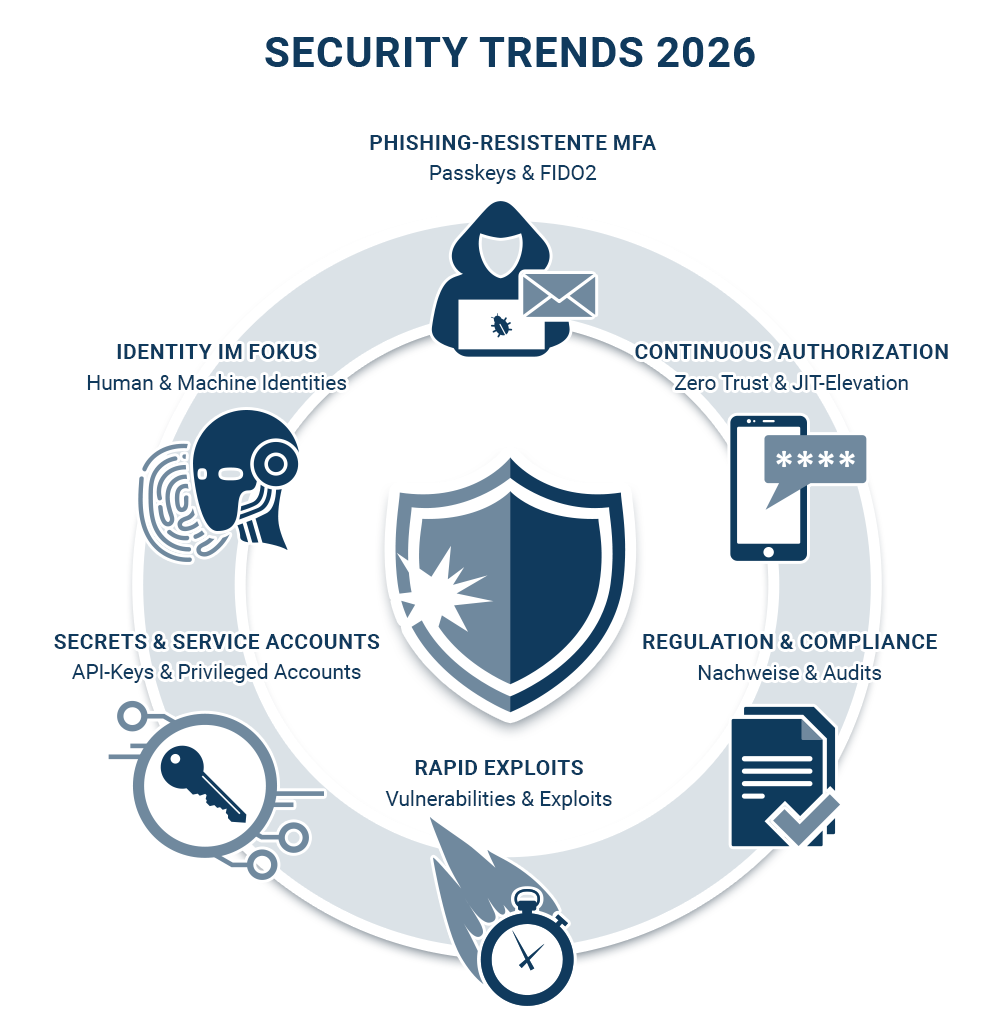
Cybersecurity trends for 2026 make one thing clear: more security tools do not automatically create better security. The real differentiator is not individual products, but integrated, customer-focused security solutions that deliver measurable business value.

Security providers create lasting value when they act as trusted partners rather than technology vendors. At the same time, the primary attack surface has fundamentally shifted—identity has replaced the network. Attackers no longer need to break into systems; they simply log in.
Security Trends

AI-powered attacks, rapidly exploited vulnerabilities, and increasingly complex regulations such as NIS2 and DORA are placing unprecedented pressure on CISOs, IT leaders, and compliance professionals.

Across all of these developments, one technology stands at the center: Identity & Access Management (IAM) has become the primary driver of cyber resilience, risk reduction, and regulatory compliance.

View of Connection

Key points at a glance

Identity is becoming a key target

IAM is becoming the most important lever in cyber defence.

Phishing-resistant MFA and passkeys are becoming the norm.

Traditional authentication is no longer sufficient.

Non-human identities and secrets are the biggest blind spot.

Transparency, rotation and least privilege are becoming crucial.

NIS2, DORA and AI are increasing the pressure on identity governance.

Continuous authorisation and auditability are becoming mandatory.

Cybersecurity Is Moving Toward Continuous Authorization

The traditional security model—authenticate once and trust continuously—is no longer suitable for cloud-native environments, APIs, and AI agents. The future of cybersecurity relies on continuous authorization through:

  • Just-in-Time (JIT) Privileges – Access is granted only when required and only for the necessary duration.
  • Just-Enough-Access (JEA) – Users receive only the minimum permissions required.
  • Continuous Session Monitoring and Adaptive Authentication – Access controls adjust dynamically as risk changes.
  • Identity Threat Detection & Response (ITDR) – Continuous detection and response across identity providers, MFA systems, tokens, and directory services.

This is where cybersecurity and Identity & Access Management converge operationally:

IAM defines the policies, Security platforms provide the telemetry, Together, they enable real-time identity security.

Why Vulnerability Exploitation Is Becoming a Critical Risk Factor

The time between vulnerability disclosure and active exploitation continues to shrink. While timely patching remains essential, Identity & Access Management determines whether a successful exploit becomes a catastrophic breach—or merely an isolated security incident.

Non-Human Identities and Secrets: The Hidden Security Gap

One of the most significant cybersecurity risks in 2026 involves compromised:

  • Service accounts
  • API keys
  • Certificates
  • Secrets

Common causes include:

  • Long-lived credentials
  • Lack of ownership
  • Excessive permissions
  • Missing discovery and credential rotation

Industry research shows that many cloud compromises originate from identity weaknesses, policy misconfigurations, and excessive privileges rather than failures of traditional network security.

Secure Connection

Why Does Vulnerability Exploitation Become a Critical Risk Factor in 2026?

With NIS2, the requirements for cybersecurity risk management measures are increasing. At the same time, DORA introduces a clear focus on resilience, testing, and third-party risk management for the financial sector and ICT service providers within its supply chain.

Important for compliance leaders: IAM becomes the backbone of audit readiness because it provides evidence such as:

  • Who had access, and when? (Permissions, groups, roles)
  • Were privileged actions controlled? (PAM, session logging)
  • Are policies effectively enforced? (Conditional Access, MFA coverage)
  • Is the Joiner/Mover/Leaver process properly managed? (IGA, access certifications)

Why Does Identity Governance Become Essential for AI and Automation?

Security teams plan to increase the use of AI and automation throughout 2026. However, the more autonomous systems operate, the more one principle applies: every automation requires effective Identity Governance (who or what is allowed to do what, with which scope, how access is revoked, and how activities are monitored).

Practical IAM guardrails for AI and agents:

  • Dedicated, strictly limited identities for each agent and use case
  • JIT tokens, short TTLs, and no long-lived secrets
  • Approval workflows for high-risk actions
  • Comprehensive logging and anomaly detection

How Should Organizations Prepare for the Security Trends of 2026?

The cybersecurity trends of 2026 can be summarized in one message: those who control identities, permissions, and sessions control risk. IAM is no longer just about authentication. It has become an operating model that combines governance (IGA), privileged access control (PAM), continuous authorization, Non-Human Identity protection, and measurable compliance with NIS2 and DORA.

If you want to reduce risk while managing greater complexity in 2026, a practical starting point includes:

  • IAM maturity and risk assessments (including Non-Human Identities)
  • A roadmap for passkeys and phishing-resistant MFA
  • A PAM and IGA program with measurable controls and audit evidence
  • ITDR use cases that detect and stop identity-based attacks at an early stage

Above all, it pays to work with an experienced cybersecurity partner that acts as a true service provider and focuses on proven, practical solutions. Together, digital security can become a genuine competitive advantage through scalable Zero Trust models, well-governed identities, and a strong security culture.

Newsletter

Stay Informed

Subscribe to our newsletter to receive regular insights into Identity & Access Management.

    By subscribing, you agree to our Privacy Policy.

    Read More

    Related Articles

    Ready for an Initial Consultation?

    Let's assess together how resilient and future-ready your Identity & Access Management strategy really is.