ITDR & Zero Trust: Detecting and Automatically Responding to Identity-Based Threats

Identity Threat Detection & Response (ITDR) enhances traditional Identity & Access Management (IAM) and Zero Trust strategies with intelligent detection of identity-based attacks. Discover how continuous behavioral analytics, context-aware risk assessments, and automated response mechanisms help protect modern identities against evolving cyber threats.

In today’s hybrid IT environments, identities have become the primary target for cyber attackers. Whether through compromised credentials, the misuse of privileged accounts, or lateral movement despite Multi-Factor Authentication (MFA), attackers increasingly focus on identities because they provide the most effective way to remain undetected. 
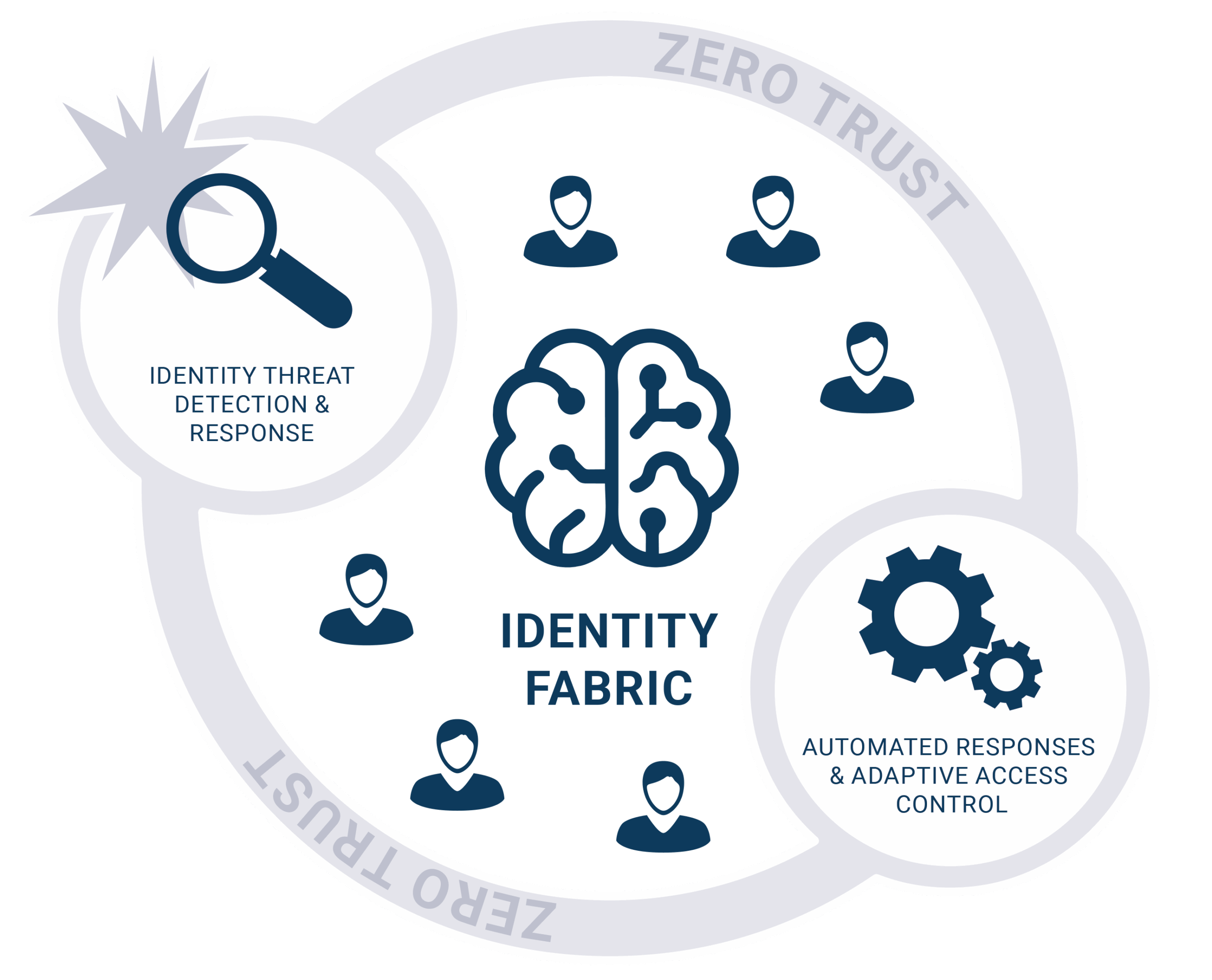
ITDR & Zero Trust

Traditional Identity & Access Management (IAM) and Identity Governance & Administration (IGA) solutions provide a strong foundation for access management, governance, and certification. However, they are often not designed to detect dynamic attack patterns in real time. This is where Identity Threat Detection & Response (ITDR) comes into play.

Zero Trust - Notebook & Icons

ITDR: A New Security Layer for Identity & Access Management

ITDR extends existing IAM architectures with a continuous layer of security analytics and threat detection. Unlike traditional security controls that rely primarily on static policies, ITDR continuously analyzes:

  • Identity behavior
  • Authentication anomalies
  • Unusual privilege usage
  • Suspicious activities across multiple systems

This additional intelligence is essential because modern identity attacks typically unfold in multiple stages. What initially appears to be a legitimate login can later evolve into privilege escalation or lateral movement.

By correlating data from logs, identity stores, directory services, cloud platforms, and authentication systems, ITDR identifies threats before they lead to business impact.

In this way, ITDR acts as the security intelligence layer within an IAM ecosystem, providing the contextual awareness that traditional identity platforms often lack.

Zero Trust and ITDR: The Perfect Combination for Cyber Resilience

Zero Trust is built on one fundamental principle: Never trust. Always verify. 

However, Zero Trust is not a product—it is a dynamic security strategy whose effectiveness depends on accurate, real-time risk assessment. ITDR provides exactly that through continuous behavioral analysis and contextual risk scoring.

Together, these technologies work as follows:

  • Zero Trust defines the security principles, including Least Privilege, Continuous Verification, and Microsegmentation.
  • Identity & Access Management (IAM) implements these principles through identities, roles, policies, and access controls.
  • Identity Threat Detection & Response (ITDR) continuously monitors identity behavior and determines whether access remains legitimate throughout each session.

By adding real-time threat intelligence, ITDR provides the “sensory system” that enables Zero Trust to make adaptive, evidence-based access decisions.

For example, if a user signs in from an unfamiliar location and immediately requests privileged access to sensitive systems, ITDR instantly increases the associated risk score. Based on this assessment, Zero Trust policies can respond automatically.

Digital Network + Keyhole

Automated Response and Adaptive Access Control

ITDR is more than a monitoring solution—it is an active response engine. When integrated with IAM and security operations, it can automatically trigger protective actions such as:

  • Adaptive Authentication – Require stronger authentication or additional MFA verification when risk levels increase.
  • Dynamic Access Restriction – Temporarily block or reduce access to sensitive resources when suspicious activity is detected.
  • Automatic Identity Containment – Terminate privileged sessions, revoke authentication tokens, or automatically disable compromised accounts.
  • Security Operations Integration – Enrich SIEM and SOAR platforms with identity intelligence to accelerate investigations and automate incident response.

For organizations, this means Zero Trust becomes operational rather than theoretical. Security controls react automatically and in real time, protecting identities even when traditional preventive controls fail.

Conclusion: ITDR as a Core Component of the Modern Identity Fabric

Within a modern Identity Fabric, such as the solutions supported by OEDIV SecuSys GmbH, ITDR represents the natural evolution of identity security. It connects governance, compliance, Identity & Access Management, and access control with continuous security intelligence, enabling organizations to detect threats, assess risk, and respond automatically. As identity-based attacks continue to dominate today’s cyber threat landscape, ITDR is no longer optional. It has become an essential pillar of modern cybersecurity strategies, ensuring that identities are not only managed—but continuously protected.

Newsletter

Stay Informed

Subscribe to our newsletter to receive regular insights into Identity & Access Management.

    By submitting this form, I consent to the processing of the data I have provided for the purpose of handling my enquiry.
    I may withdraw this consent at any time with future effect. Further information: Privacy Policy.
    Read More

    Related Articles

    Ready for an Initial Consultation?

    Let's assess together how resilient and future-ready your Identity & Access Management strategy really is.